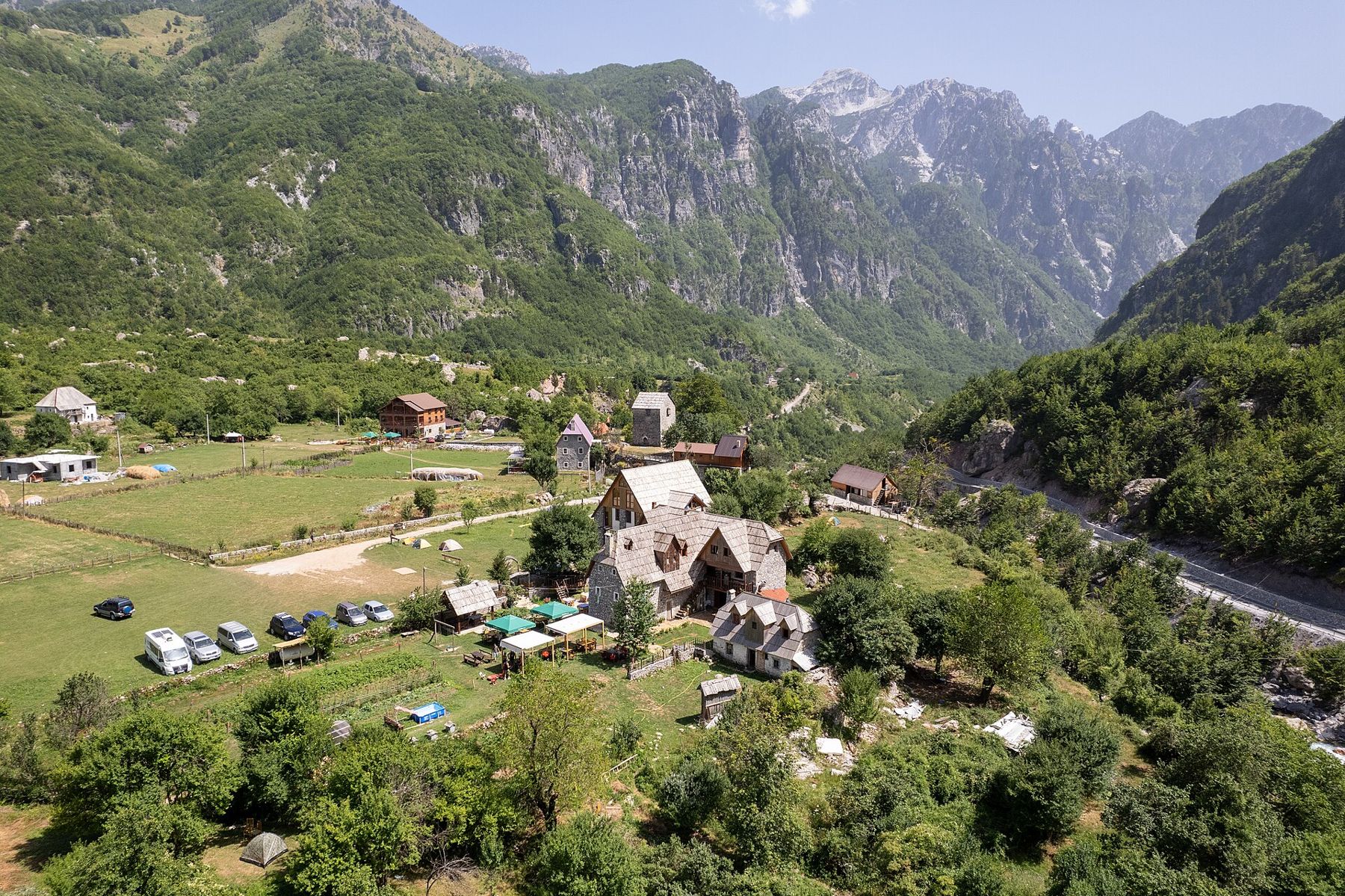
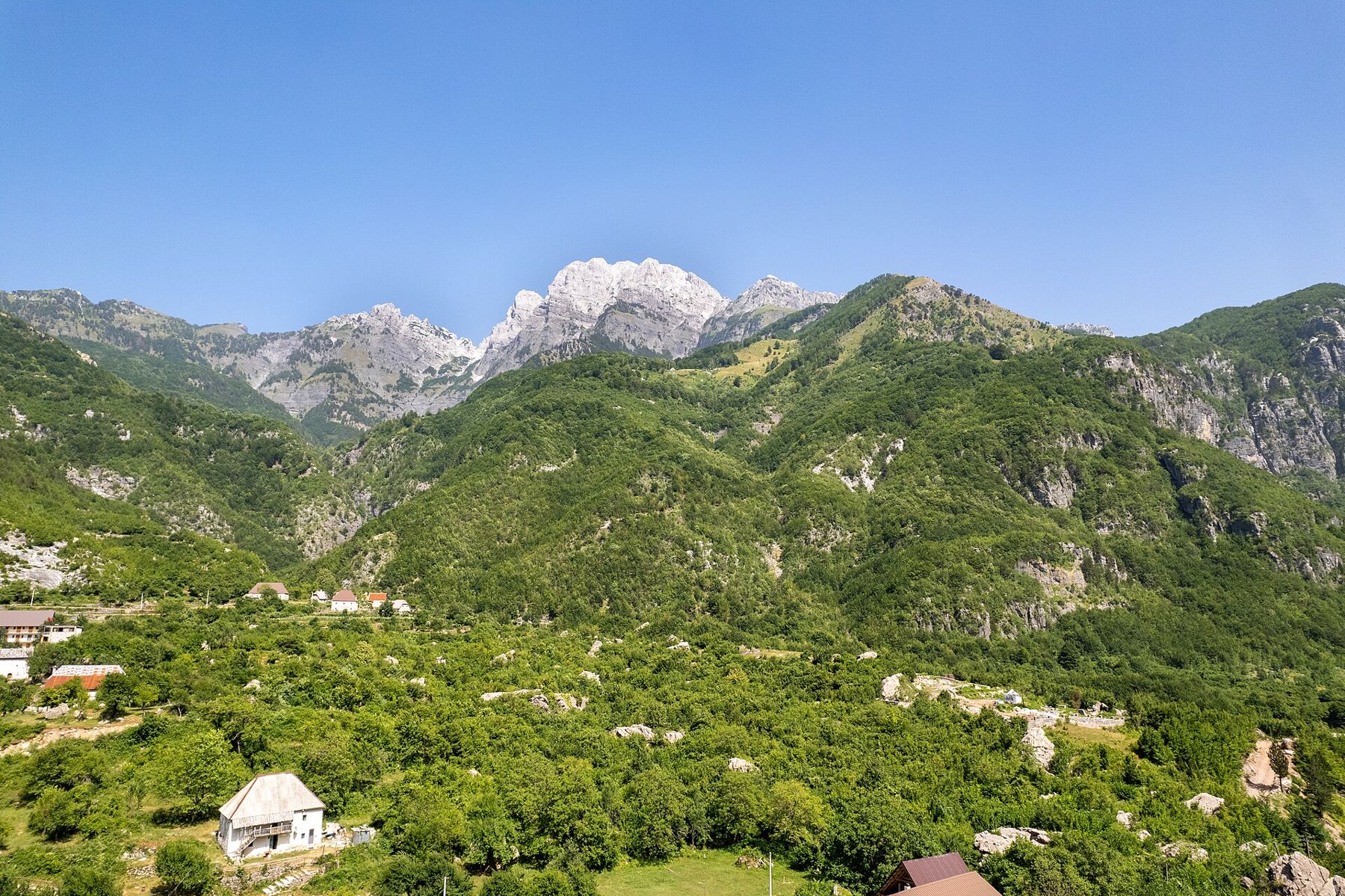
The road comes over the top of the pass and the land falls away. Below is a long green trench between walls of grey limestone, the peaks along its rim still streaked with snow in June. Far down on the valley floor are scattered stone houses with steep, dark roofs, a white thread of river, a few fields, and a church spire. Nothing about the view suggests a village in the ordinary sense. The houses are spread out across the slopes, each with its own land, as if every family had chosen its spot and kept its distance.
This is Theth, in the heart of the Bjeshkët e Nemuna, the Accursed Mountains. For most of its history it was among the most isolated places in Europe, cut off by snow for months each year. That has changed, but less than you might think.
A valley apart
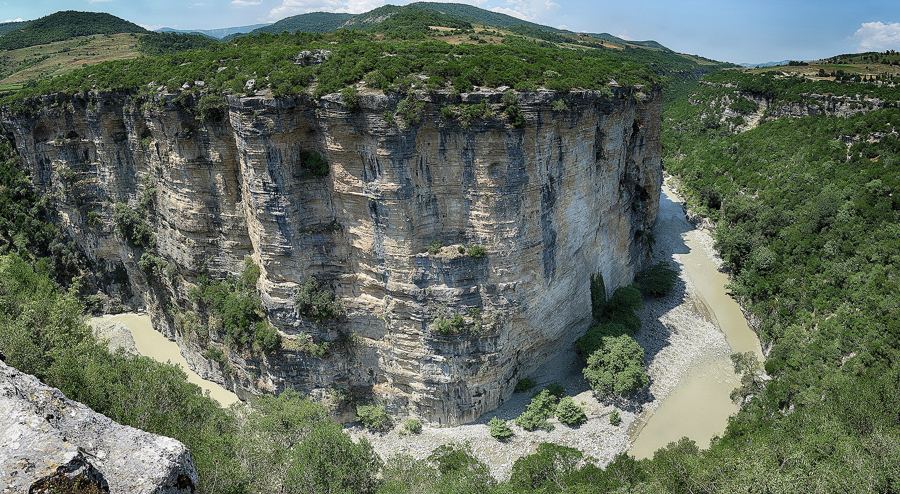
Theth lies in the far north of Albania, inland from Shkodër, close to the border with Montenegro. The valley runs roughly north to south, drained by the Theth river, which flows down to join the Shala. The surrounding peaks rise well above two thousand metres, and their rock is pale limestone, cracked and terraced and pocked with sinkholes, so that the walls of the valley look like the ruins of enormous buildings.
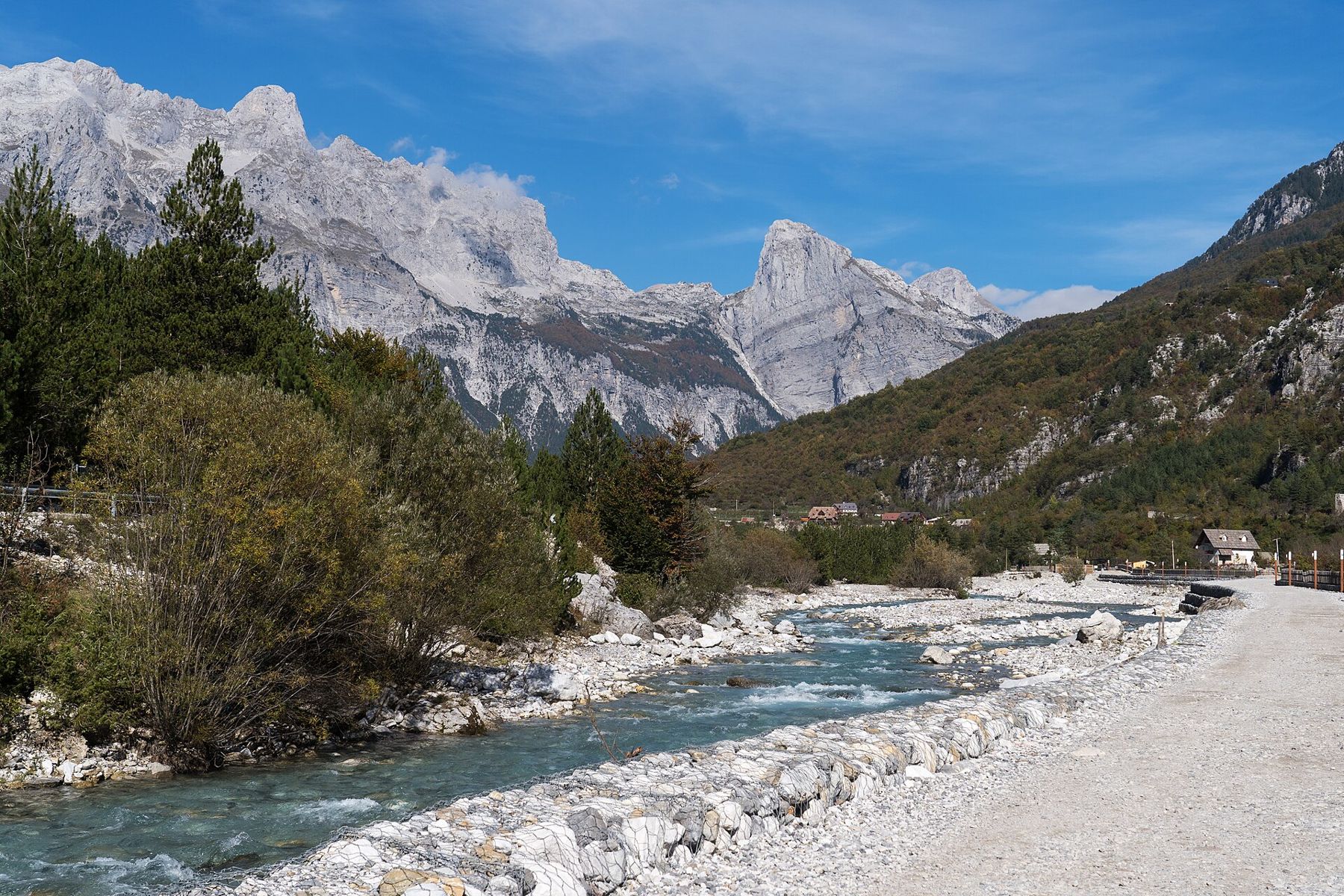
The people of Theth are Catholic highlanders, part of the old tribal world of the northern Albanian mountains, organised by clan and governed for centuries by customary law. That law, the Kanun, codified under the name of Lekë Dukagjini, regulated everything from hospitality to property to the duty of revenge. The British traveller Edith Durham passed through in 1908 and wrote about the valley, its people and their customs in her book on the high Albanian mountains, and her account is still one of the best ways into this world.
The area became a national park in 1966. In the communist decades many families stayed, farming small plots and keeping animals on the high pastures in summer. After 1990 the population fell steeply as people moved to Shkodër, Tirana and abroad. Many houses emptied. Then, from the 2000s, walkers began to arrive, and families returned to turn their homes into guesthouses. Most of the visitors you meet in Theth today sleep in one of them, eating at the family table.
The houses themselves are worth looking at closely. The older ones are built of rough stone with walls a metre thick, small windows set high, and roofs of wooden shingles pitched steeply to shed the snow. The ground floor was for animals and stores, the floor above for the family, warmed by the hearth. Several still have the slits and narrow openings of buildings designed with defence in mind. Around them, dry-stone walls divide small fields of maize, potatoes and hay, and orchards of plum and walnut.
The church and the lock-in tower
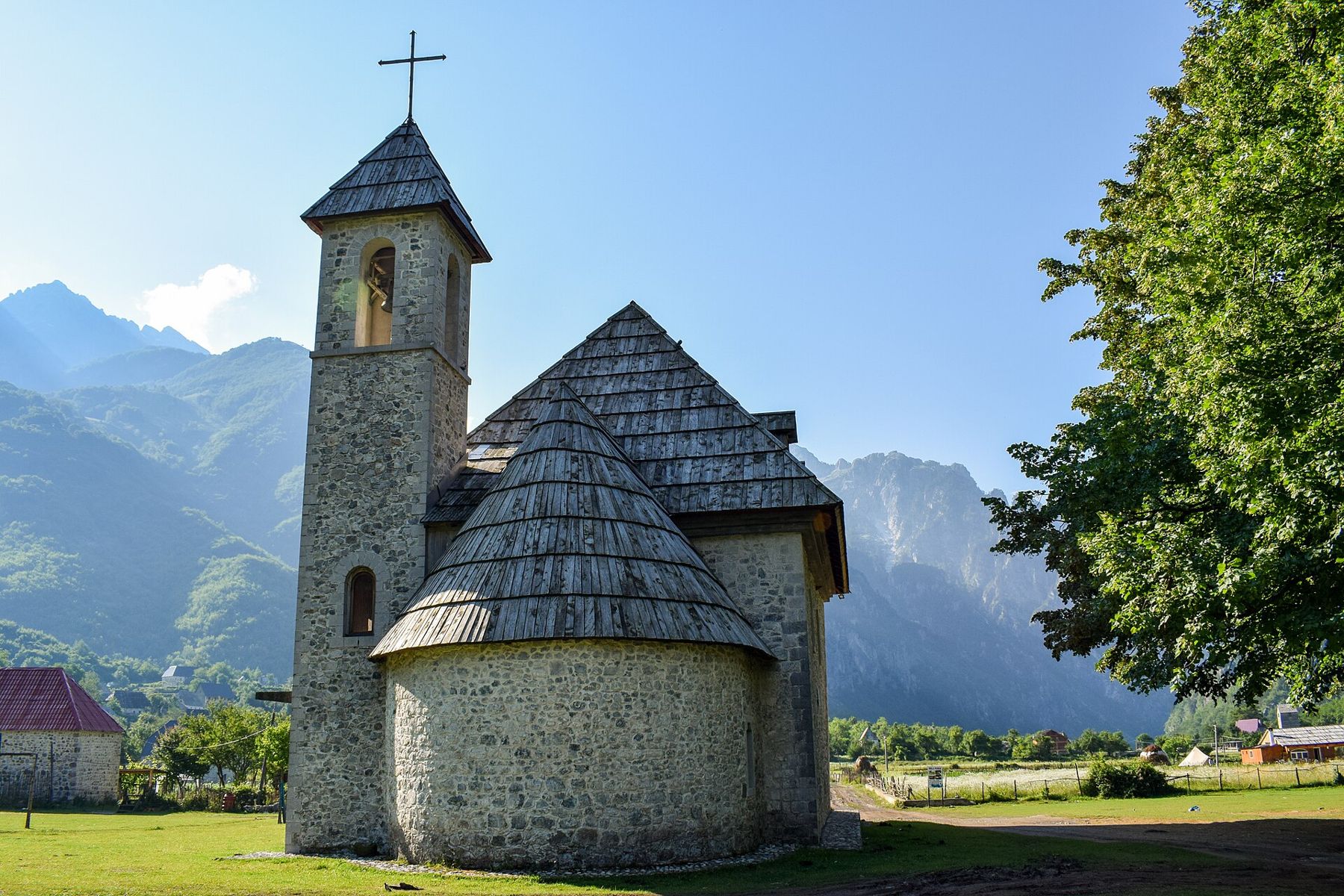
The small stone church of Theth stands in a meadow near the centre of the valley, with a pitched roof and a short bell tower, against a backdrop of the peaks. It dates from the late nineteenth century. Under communism, when religion was banned, it was closed and used for other purposes; it was restored and returned to worship after 1990. It is probably the most photographed building in northern Albania, and with reason: the setting is extraordinary.
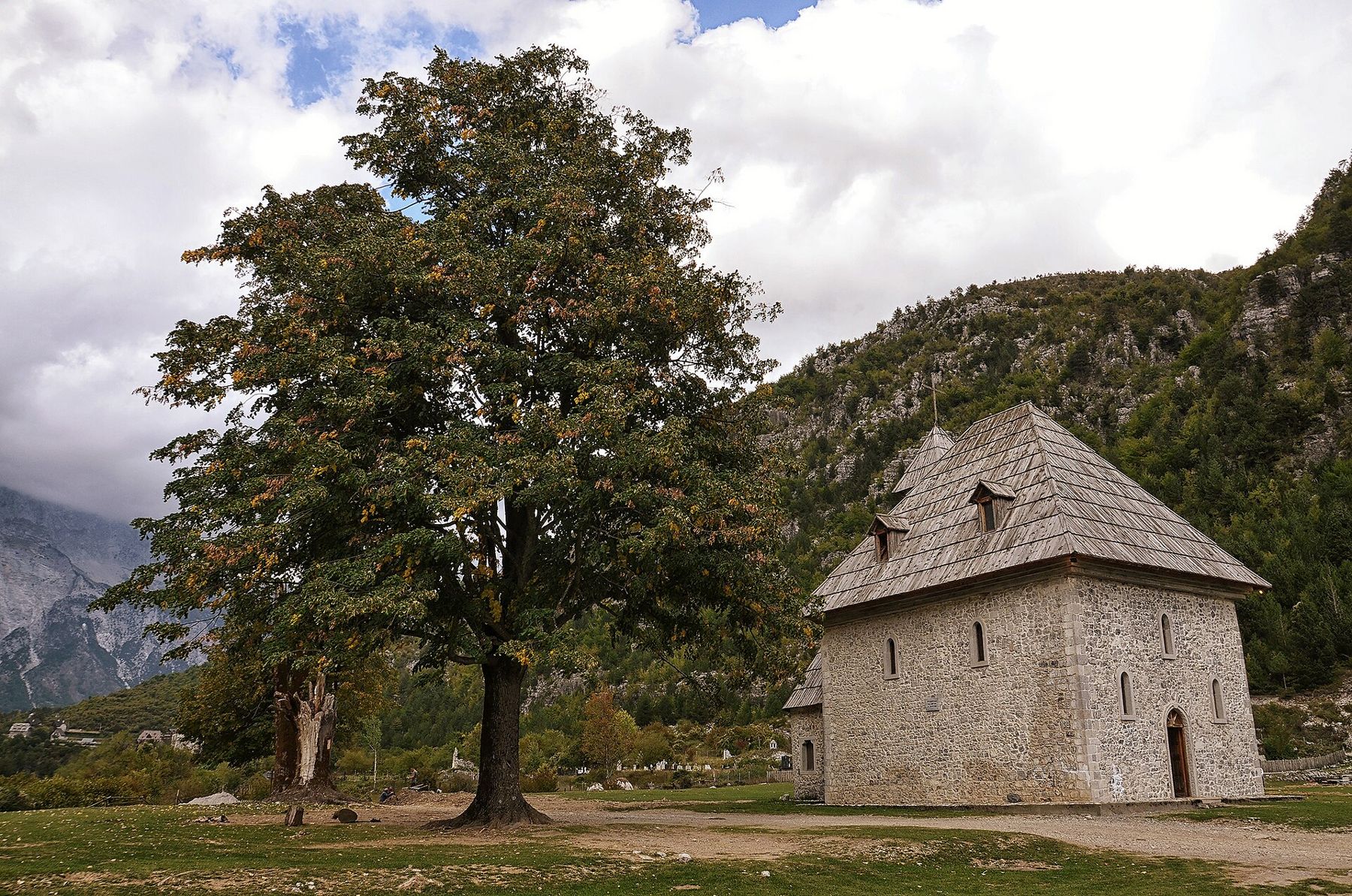
A short walk away is the kulla, the lock-in tower. In the world of the Kanun, a man whose family was in blood feud could be killed in revenge for a killing by one of his relatives. To stay alive he would shut himself inside a fortified tower, sometimes for years, while negotiations went on. The tower at Theth is a square stone building with thick walls, small windows and narrow loopholes, and it has been restored as a small museum. Standing inside, in the dim light, you feel very directly what such a life meant.
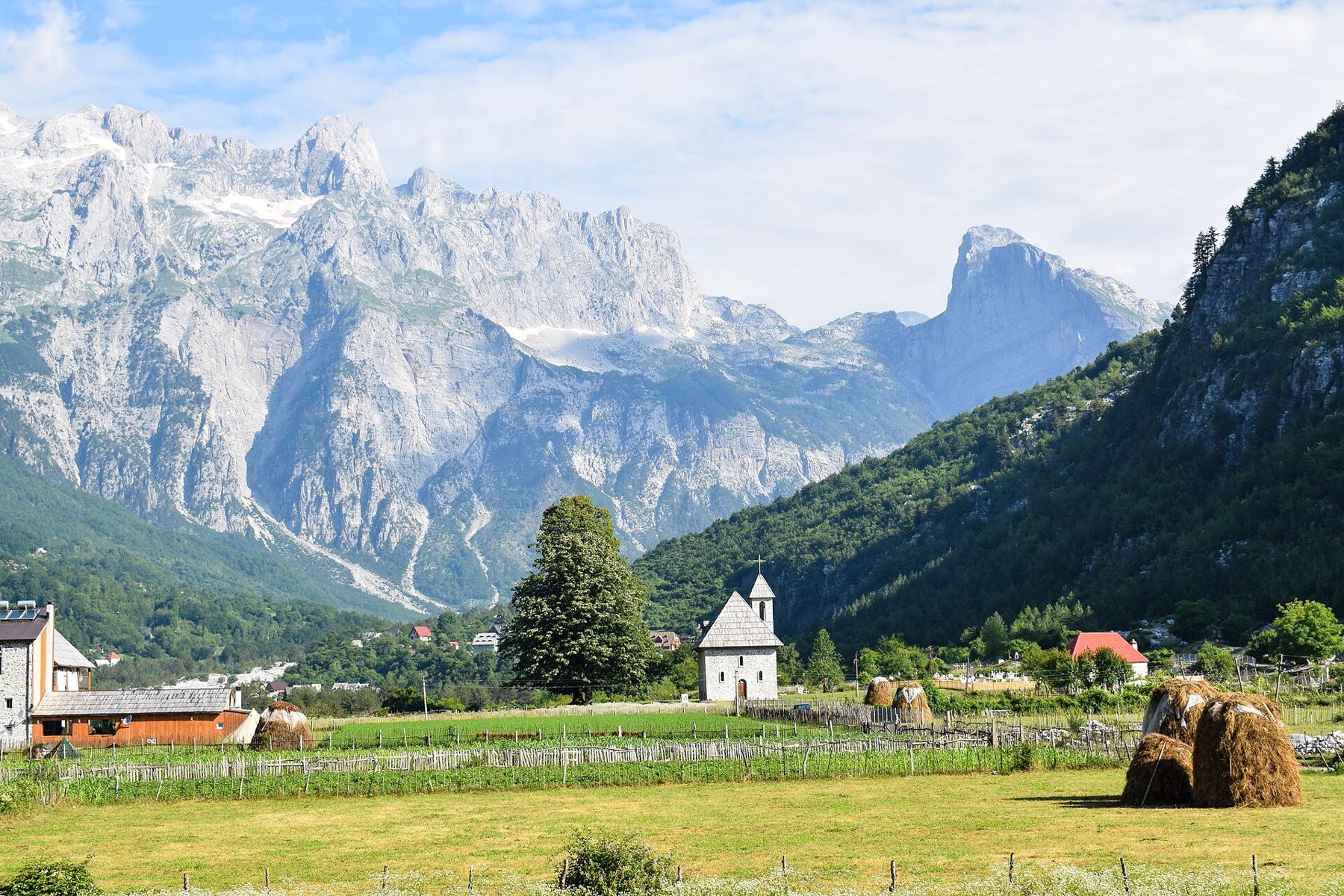
The houses are spread out across the slopes, each with its own land, as if every family had chosen its spot and kept its distance.
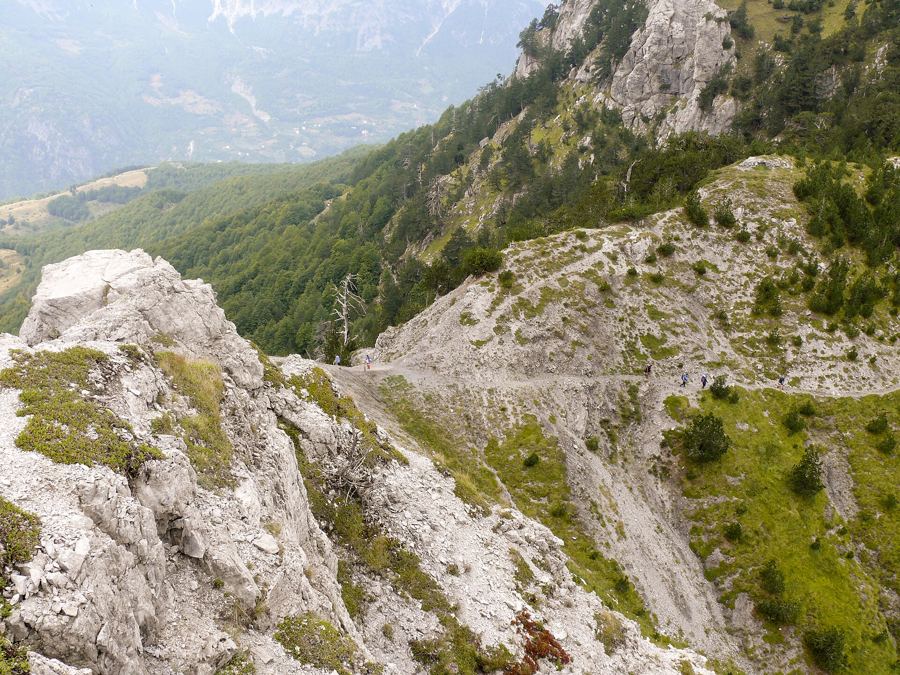 Read nextOver the Valbona Pass, from Valbona to Theth
Grunas and the Blue Eye
From the centre of the valley a path follows the river south and climbs to the Grunas waterfall, which drops in a single white column, some tens of metres, into a pool in a rocky amphitheatre. It is an easy walk of about an hour each way, suitable for most people, and the spray cools the air on the hottest day. Close by, the river cuts through a narrow gorge, worth a look from the path.
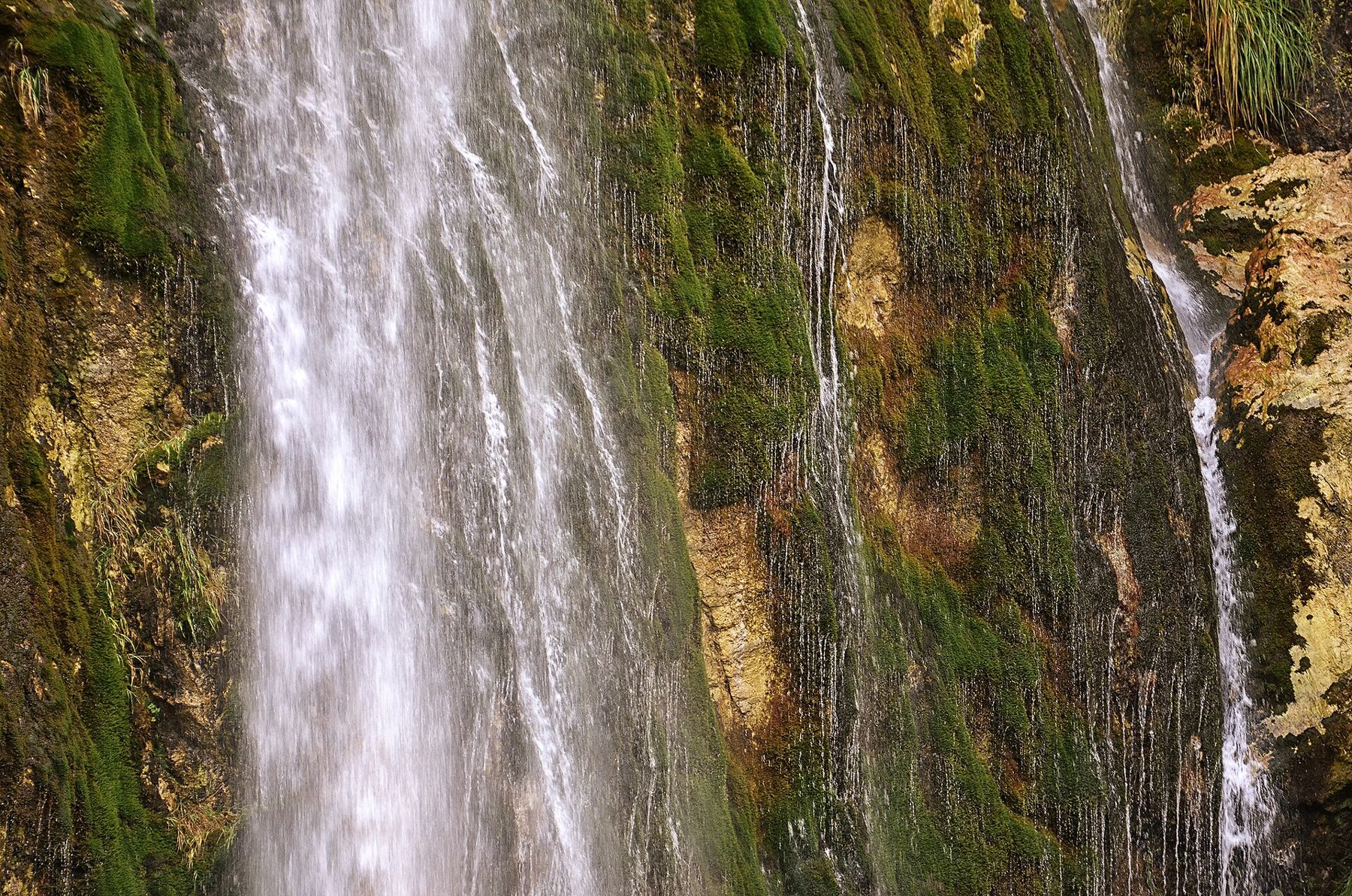
The longer walk is to the Blue Eye of Theth, a pool of startling turquoise below a small waterfall, further down the valley beyond the hamlets of Nderlysaj and Kaprre. Allow most of a day there and back. The path follows the river, with some rough sections and stream crossings, and there are places to buy drinks and simple food in the high season. The water in the pool is extremely cold, even in August.
Both walks are on clear paths, but conditions vary with the season, the weather and the state of the river after rain. Ask your hosts before setting out, and start early in summer.
The new road
For decades, reaching Theth meant a long, rough drive over the Thorë pass on a gravel track, passable only by four-wheel drive or the furgons that bounced up and down it once a day. The track was closed by snow for much of the winter. In recent years the road from Shkodër has been paved all the way to the valley, and the journey has become far easier and shorter.
The road has changed Theth. Day-trippers now come up from Shkodër and even Tirana, new guesthouses and cafés have appeared, and in summer the valley floor can be busy. People argue about whether this is good. Families who could barely make a living now have income; the quiet that drew the first walkers is harder to find in August. Both things are true.
The pass is high, and snow can still close it in winter. Minibuses run from Shkodër in the walking season, and schedules change. Our story on Shkodër covers the city that is the gateway to the north.
Walking safely
Theth is a mountain place, and the mountains are serious. Weather changes quickly: a clear morning can bring afternoon thunderstorms, especially in summer, and the temperature at the passes is much lower than on the valley floor. Snow lingers on the high routes into June, and sometimes later on the north-facing slopes.
For any walk beyond the valley, carry enough water, warm and waterproof layers, food, a map or an offline map on your phone, and a charged battery. Mobile signal is patchy. Tell your hosts where you are going and when you expect to be back. Local guides can be arranged through the guesthouses, and for the longer high routes, or early and late in the season, hiring one is a sensible choice. The most famous walk, over the pass to Valbona, is covered in our Valbona to Theth route.
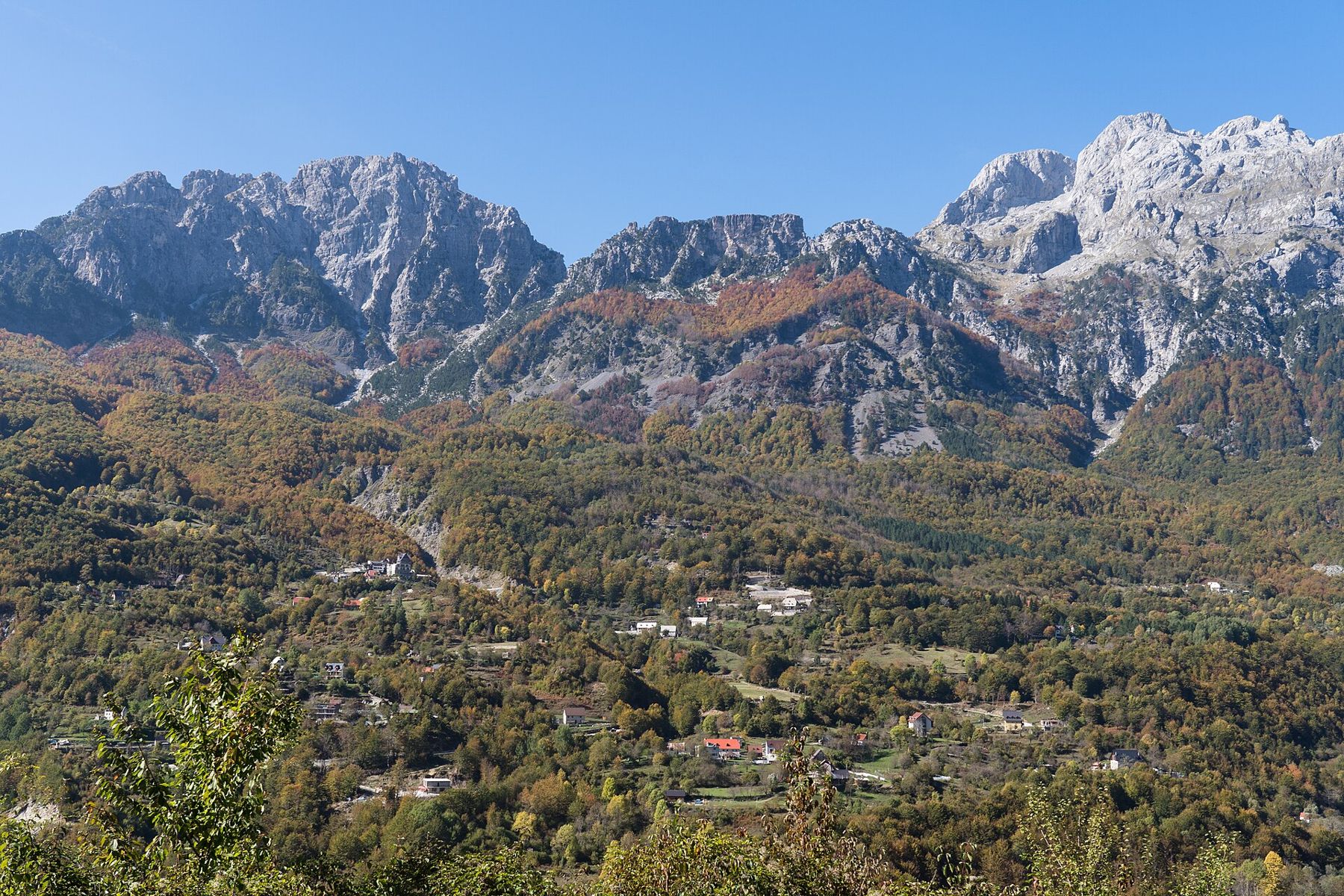
The best months are June, when the meadows are full of flowers and the snow is still on the peaks, and September, when the light is golden, the crowds have gone and the beech woods begin to turn.
Staying in the valley
A night or two is the minimum to do Theth justice. The guesthouses are mostly family homes, with simple rooms and big dinners of home-produced cheese, yoghurt, bread, vegetables, meat and raki. Meals are often eaten together at long tables, and the conversation runs in several languages.
Most guesthouses open from late spring to autumn, and a handful stay open longer. It is wise to book ahead in July and August and to bring enough cash, since card payments and cash machines cannot be relied on in the valley.
Evenings are the reward. The day visitors leave, the light goes amber on the peaks, then pink, then grey, and the valley falls quiet except for the river. Cowbells sound somewhere up the slope. The stars come out over the rim of the mountains, and you understand, for a moment, why people stayed here through all those winters.
Filed under Mountains