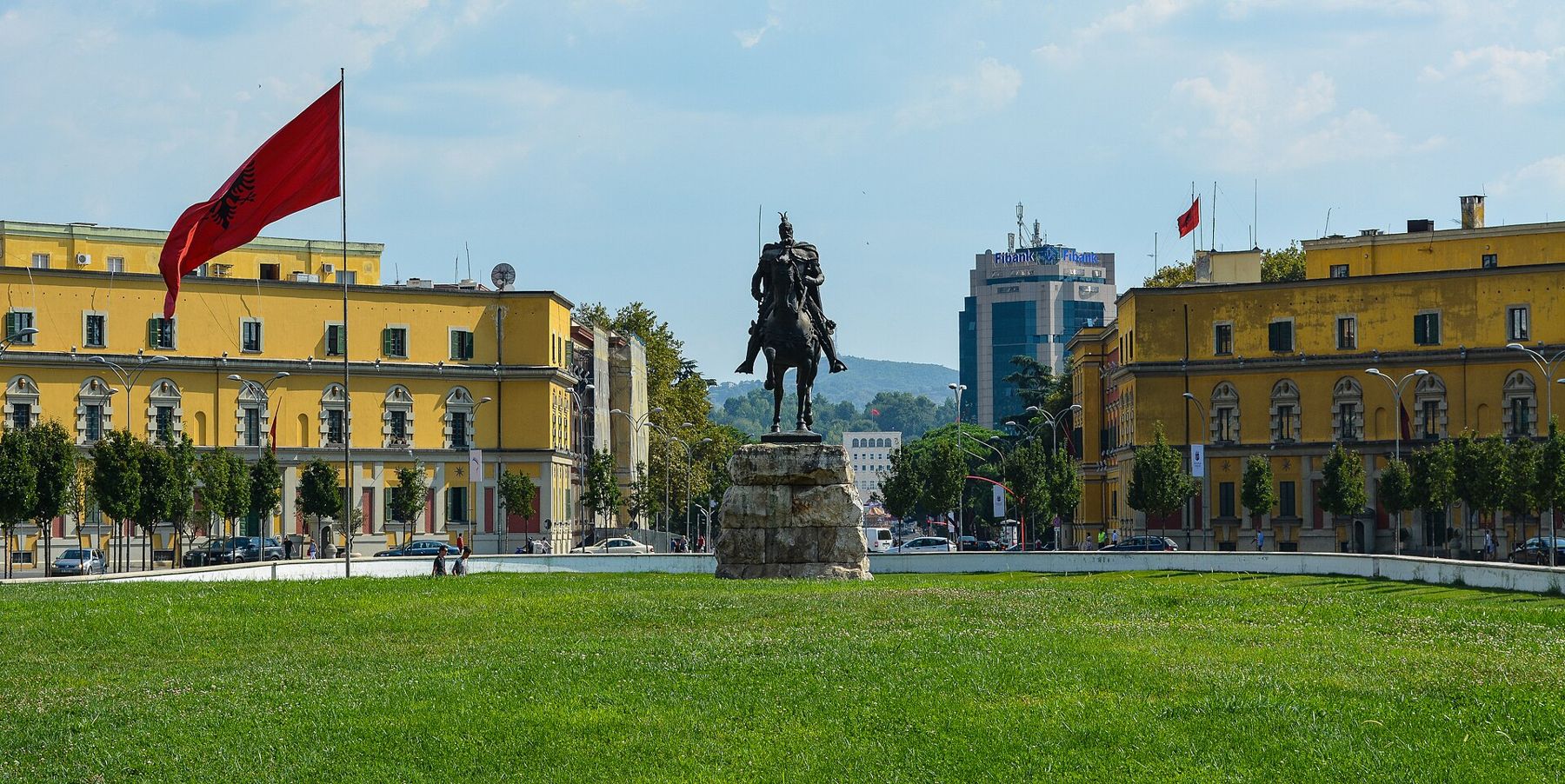
Walk into Skanderbeg Square from any side street and the city seems to step back. The noise of Tirana, its scooters and taxis and building sites, drops away behind a belt of trees, and in front of you is a sheet of stone so wide that people crossing it look small and slow. Pigeons settle in the middle. A child on a scooter makes a long curve towards the statue. Somebody's grandfather stands with his hands behind his back, looking at nothing in particular.
For most of its life this was not a place to stand. It was a roundabout, a vast one, with buses and cars circling a patch of grass and the statue of the national hero marooned in the traffic. The square that exists today dates from a redesign finished in 2017, which took the cars out, raised the centre very slightly and paved the whole space in stone brought from different parts of Albania. The result is the city's open room: a floor laid for everybody, with the country's story arranged around its walls.
The rider in the middle
Gjergj Kastrioti, known as Skanderbeg, rides a bronze horse caught mid-step. He was a fifteenth-century nobleman who had served the Ottoman sultan, broke away in 1443 and held much of the Albanian highlands against Ottoman armies for twenty-five years, from his base at Krujë. He died in 1468, and the statue was unveiled in 1968, five hundred years later.
The statue is the fixed point people use to give directions and to meet. It is also the backdrop to wedding photographs, school trips and political rallies, and on national holidays the national flag flying over the square is the red and black of his banner, with the double-headed eagle. If you want the full story of the man, his castle town is an hour north, and the museum there is devoted to him; Krujë makes the natural next step after this square.
The mosque and the clock
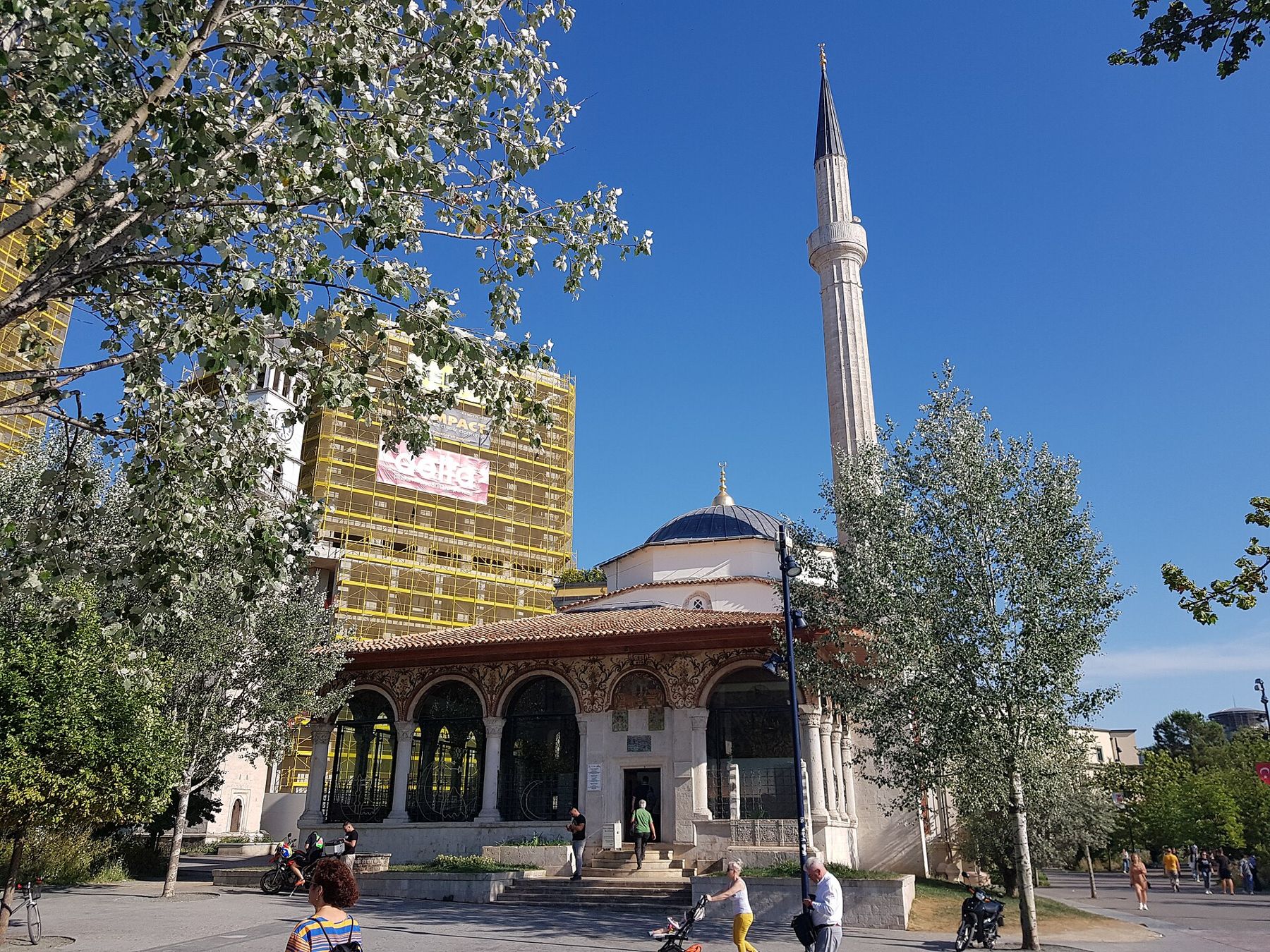
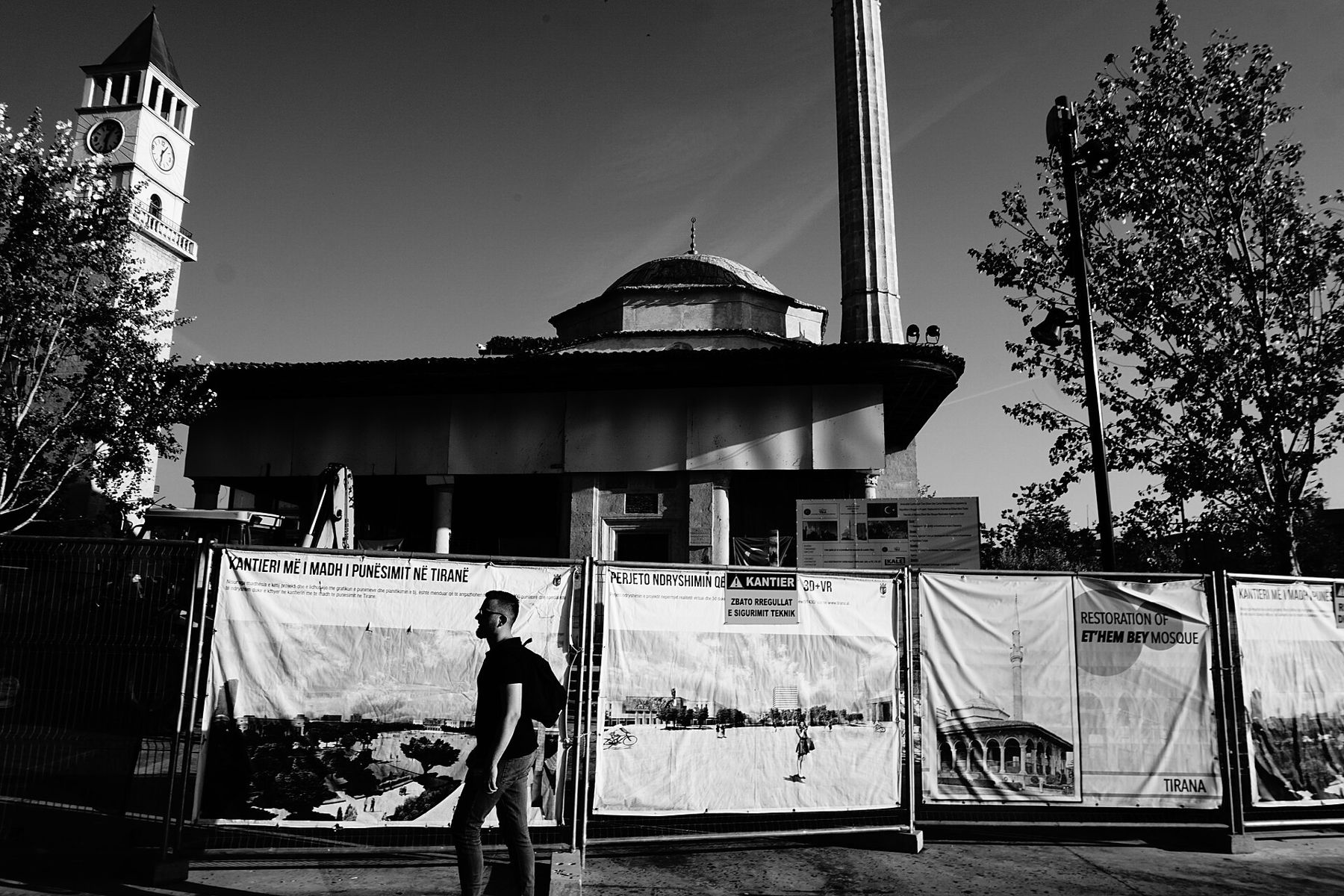
On the south-eastern corner stands the oldest building on the square, and the smallest of the important ones. The Et'hem Bey Mosque was begun at the end of the eighteenth century and completed in the early nineteenth by Haxhi Et'hem Bey. From outside it looks modest: a dome, a slim minaret, a portico of arches. Inside, and under the portico, the walls are painted with trees, waterfalls, bridges and small towns, a landscape scheme that is unusual in mosque decoration and gives the building a quiet, almost domestic feel.
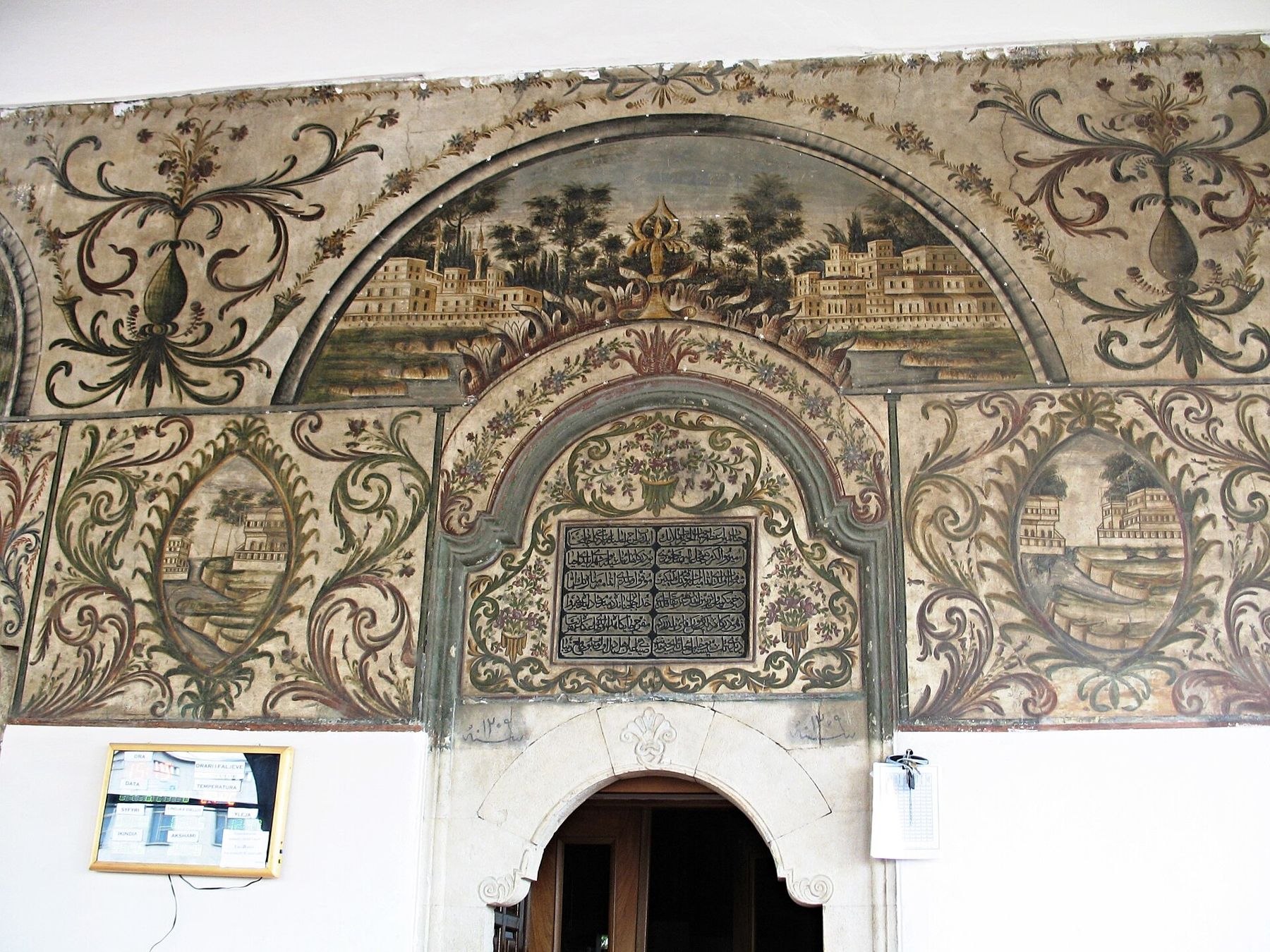
Under the communist government, which declared Albania an atheist state in 1967, the mosque was closed to worship, though it survived as a cultural monument. In January 1991, as the one-party system was coming apart, a large crowd gathered here to pray, and many Albanians still remember that day as one of the moments when it became clear that things had changed. Visitors are welcome outside prayer times; dress modestly, take your shoes off at the door, and keep your voice low.
Beside it rises the Clock Tower, built in the 1820s and also linked to Haxhi Et'hem Bey. It is a plain stone shaft topped with a clock and a small lookout, and for a long time it was the tallest thing in a low town of courtyards and gardens. Its opening times change, but when it is open the climb is short and the view over the square is worth the stairs.
The mosaic and the museum
The northern side is held by the National History Museum, a long, flat-roofed block opened in 1981. Above the entrance is the mosaic that has become one of the city's emblems: a crowd of Albanians moving left to right across the facade, from figures in ancient dress through medieval fighters and peasants to a woman holding a rifle and a man with a flag. It was made in the communist period and it tells the story the state wanted told, of a people always fighting for freedom, but it is also a striking piece of design, and the colours carry right across the square.
 Read nextThe New Bazaar, from first crates to last raki
The result is the city's open room: a floor laid for everybody, with the country's story arranged around its walls.
The museum itself is the most complete single overview of Albanian history in the country, from prehistoric finds and Illyrian and Greek pieces to the medieval period, the Ottoman centuries, the declaration of independence at Vlorë in 1912 and the twentieth century. Some galleries are better presented than others, and parts have been under renovation in recent years, so expect a mixture. Give it at least an hour.
A few steps from the museum, on the open stone, there is nothing to see, and that is part of the story. A large statue of Enver Hoxha once stood on the square. In February 1991 a crowd pulled it down, and the photographs of that afternoon are among the best-known images of the end of the communist era in Albania.
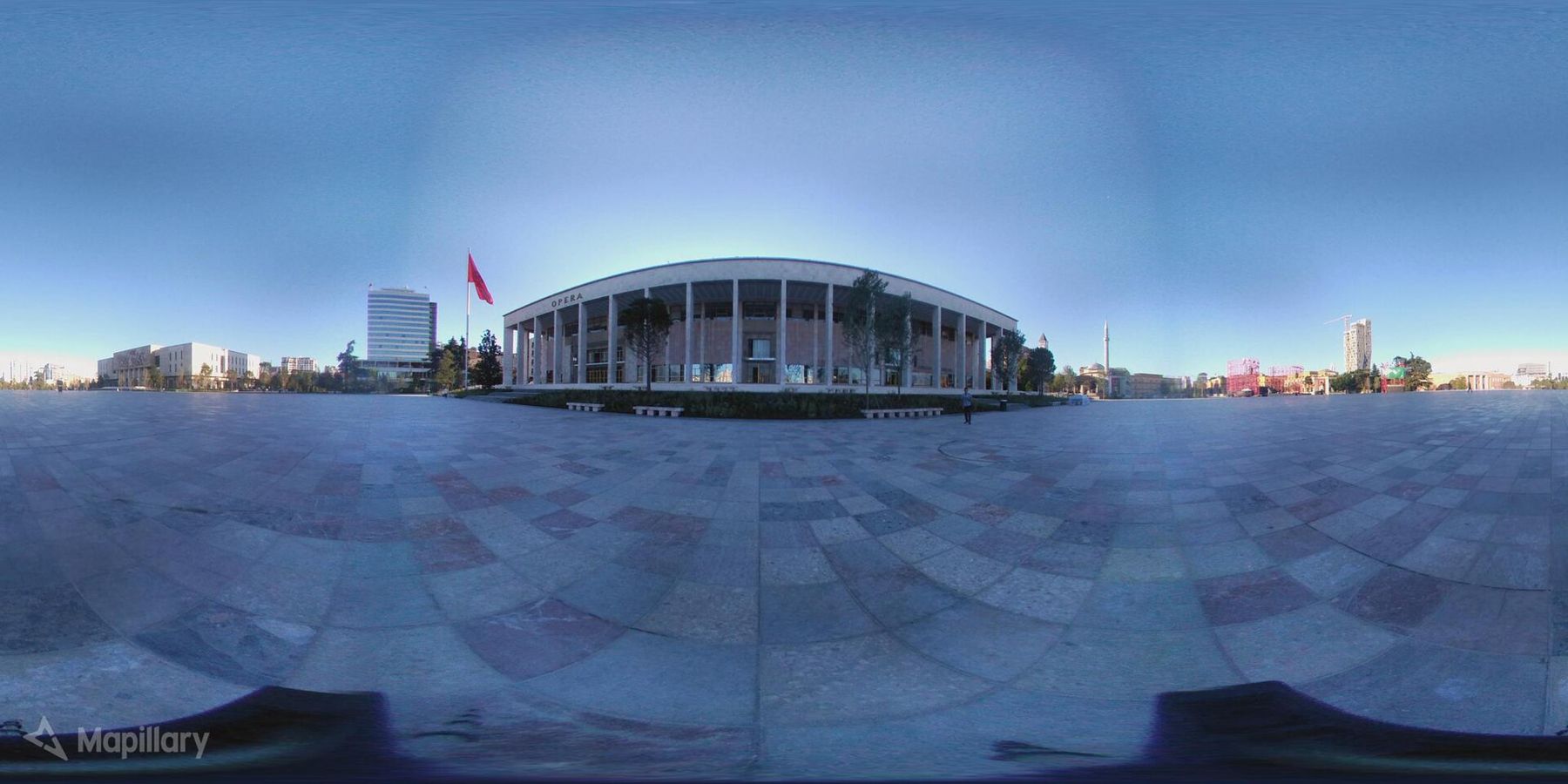
The palace, the ministries and the hotel
The eastern side is the Palace of Culture, a long colonnaded building begun at the end of the 1950s and finished in the mid-1960s. It holds the National Theatre of Opera and Ballet and the National Library, and its steps are a good place to sit and watch the square, especially on summer evenings when the stone gives back the heat of the day. The building stands on ground that was once part of the town's old bazaar, cleared in the communist rebuilding of the centre.
To the south, across the road, the ministries are older still. They were built in the 1930s by Italian architects, in a style that mixes the classical with the plain lines of the period: ochre and terracotta walls, long rows of shuttered windows, arcades at street level. With the city hall, they frame the start of the main boulevard, which runs south towards the university and the Grand Park.
On the northern side, the tall hotel block of the 1970s and a growing crop of new towers behind it are a reminder that Tirana is still building fast. The skyline changes from year to year, and the square is one of the few places in the centre wide enough to see it whole.
The stone floor
Look down. The redesign laid the square in slabs of stone from quarries in different parts of Albania, in greys, pinks, creams and rusty browns, set in a loose pattern so that the floor reads as a single surface but changes colour as you walk. The centre is raised a little, so the square has the faint shape of a very low pyramid, and rain runs outwards to the edges.
Around the edge, the designers planted trees and gardens to soften the boundary between the open stone and the streets. In the heat of summer this belt is where people go, to benches in the shade, while the middle of the square stays empty until the sun drops. Then the floor fills: families, couples, teenagers on bicycles, men in pairs walking slowly and talking with their hands. This evening walk, the xhiro, is one of the habits of Albanian towns, and here it has room. It ends, like most things in Tirana, with coffee; the café habit runs all day in the streets around.
Using the square
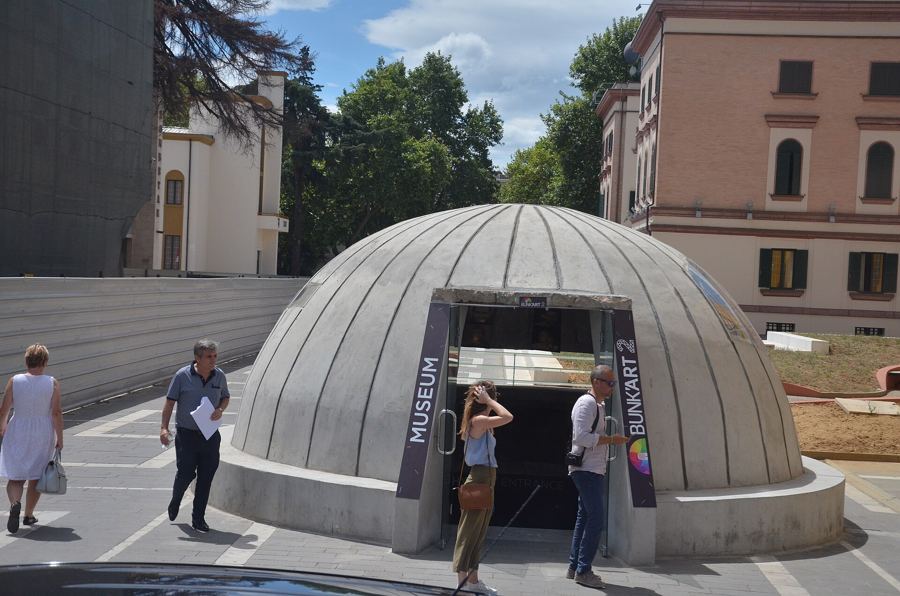
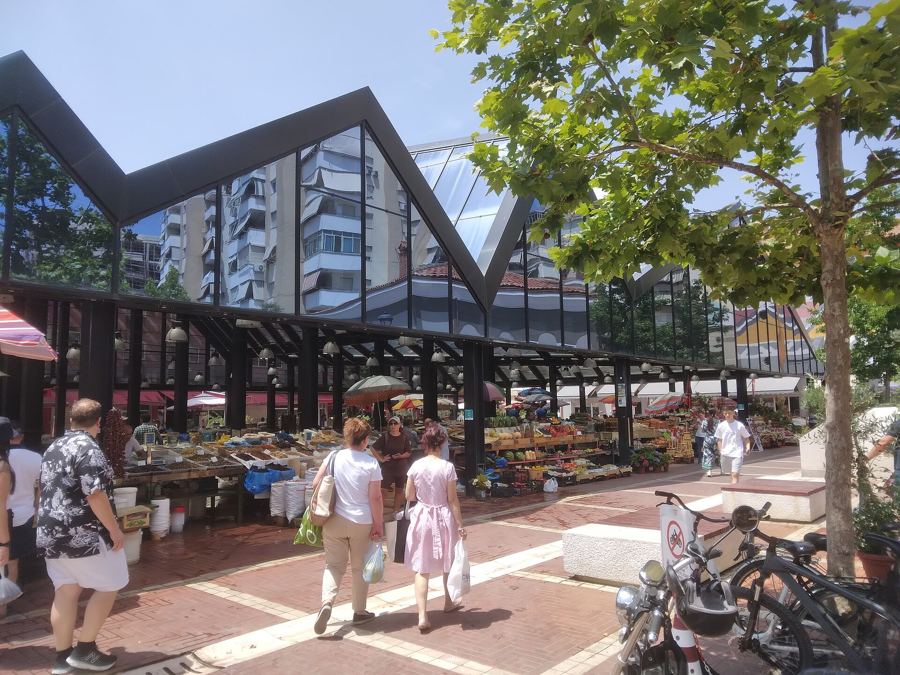
The square works as a starting point for almost anything in the centre. The museum of surveillance and the downtown bunker of Bunk'Art 2 are each a few minutes' walk away. The New Bazaar market quarter lies a short walk to the north-east, behind the Palace of Culture and the mosque.
It is busiest on weekend evenings and during public events, when stages and screens go up and the open floor is partly fenced. In December a Christmas market fills part of it. On a weekday morning, by contrast, it can be almost empty, and that is the best time to see the scale of it and read the buildings at your own pace.
There is no entry fee to the square itself, and no particular route. Walk the edges clockwise, starting at the statue: the museum, the hotel corner, the mosque and clock, the palace steps, the ministries. Then cross the middle on the diagonal, from one corner to the other, and notice how long it takes. That walk, more than any building, is what the square is for.
Filed under Tirana