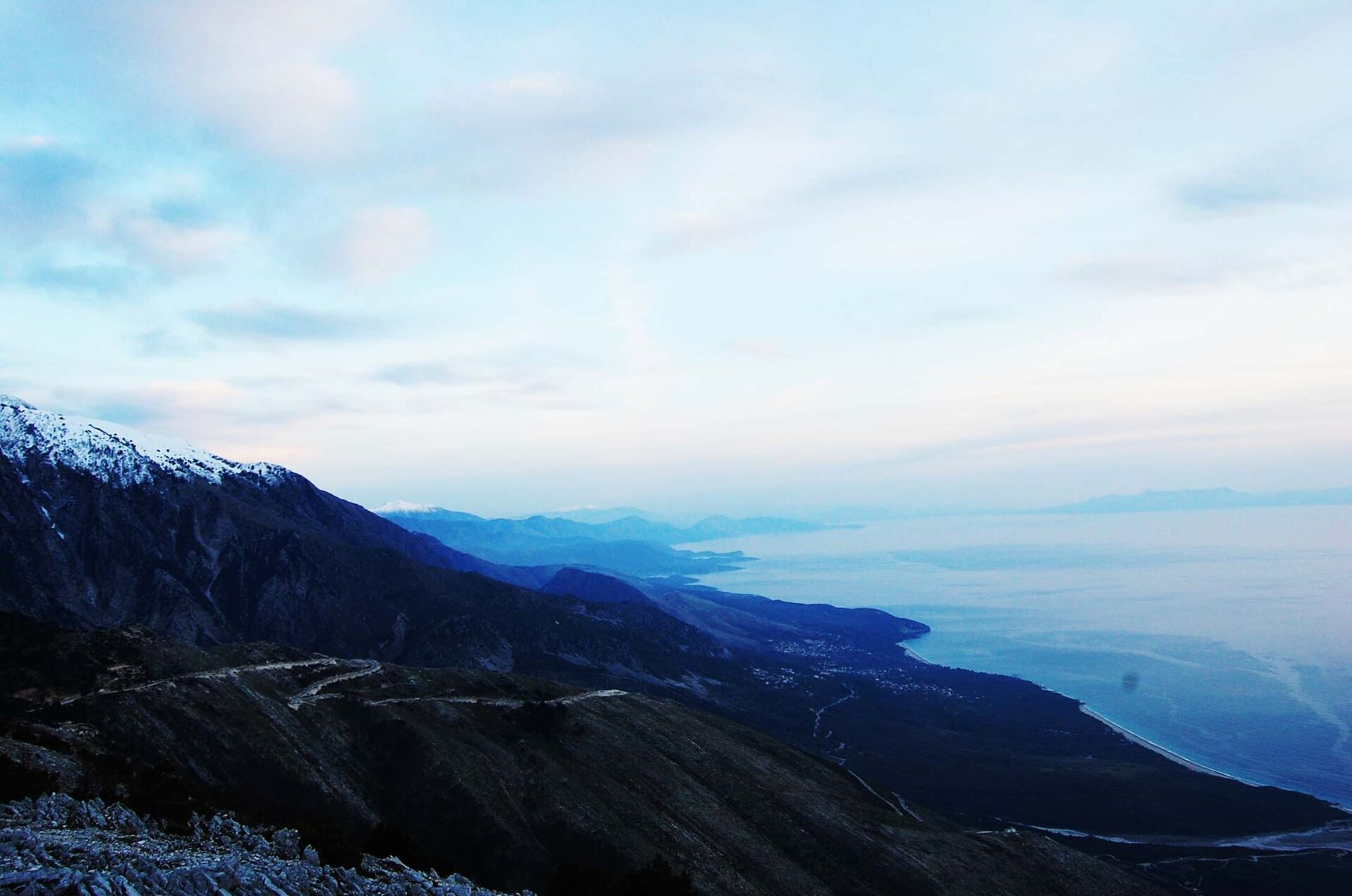
The first sight of the sea comes all at once. You climb out of Orikum through switchbacks and black pine, the air turns cool and resinous, and then at the top of the Llogara Pass the mountain simply stops. Below, about a thousand metres down, the Ionian lies flat and very blue, with the shadow of Corfu far off to the south and a single thread of road unspooling along the shore.
That road is the Albanian Riviera. It is not a resort strip so much as a chain of separate bays, each with its own village up the slope and its own beach at the bottom, linked by a highway that climbs and falls with the land. The pleasure of it is the sequence: pass, cove, village, headland, cove again. Taken in a hurry it blurs. Taken bay by bay it makes sense.
Over the Llogara Pass
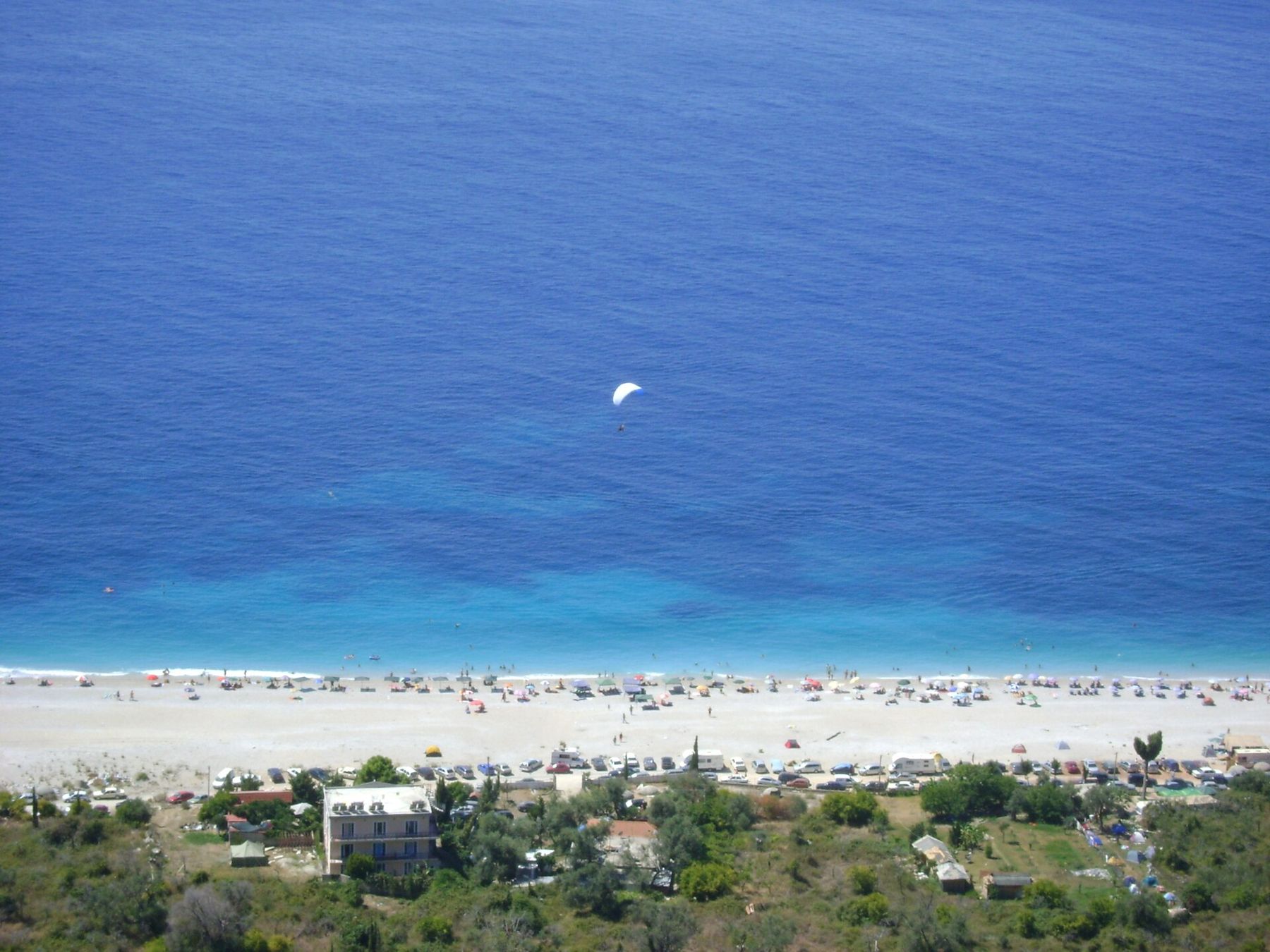
The pass sits inside the Llogara National Park, a ridge of black pine and fir between the Bay of Vlorë and the open sea. The trees on the exposed crest grow bent and flagged by the wind, and in summer the roadside stalls sell honey, mountain tea and grilled meat to drivers who stop at the viewpoints. Paragliders sometimes launch from the slopes when the wind is steady.
Below the pass on the sea side lies Palasë, where a long pebble beach runs north under the mountain. Tradition holds that Julius Caesar landed near here in 48 BC during his war with Pompey, and the saddle above is still called Caesar's Pass. Whatever the truth of the landing, the geography explains why an army would choose it: this is one of the few places where the mountains give way to a usable shore.
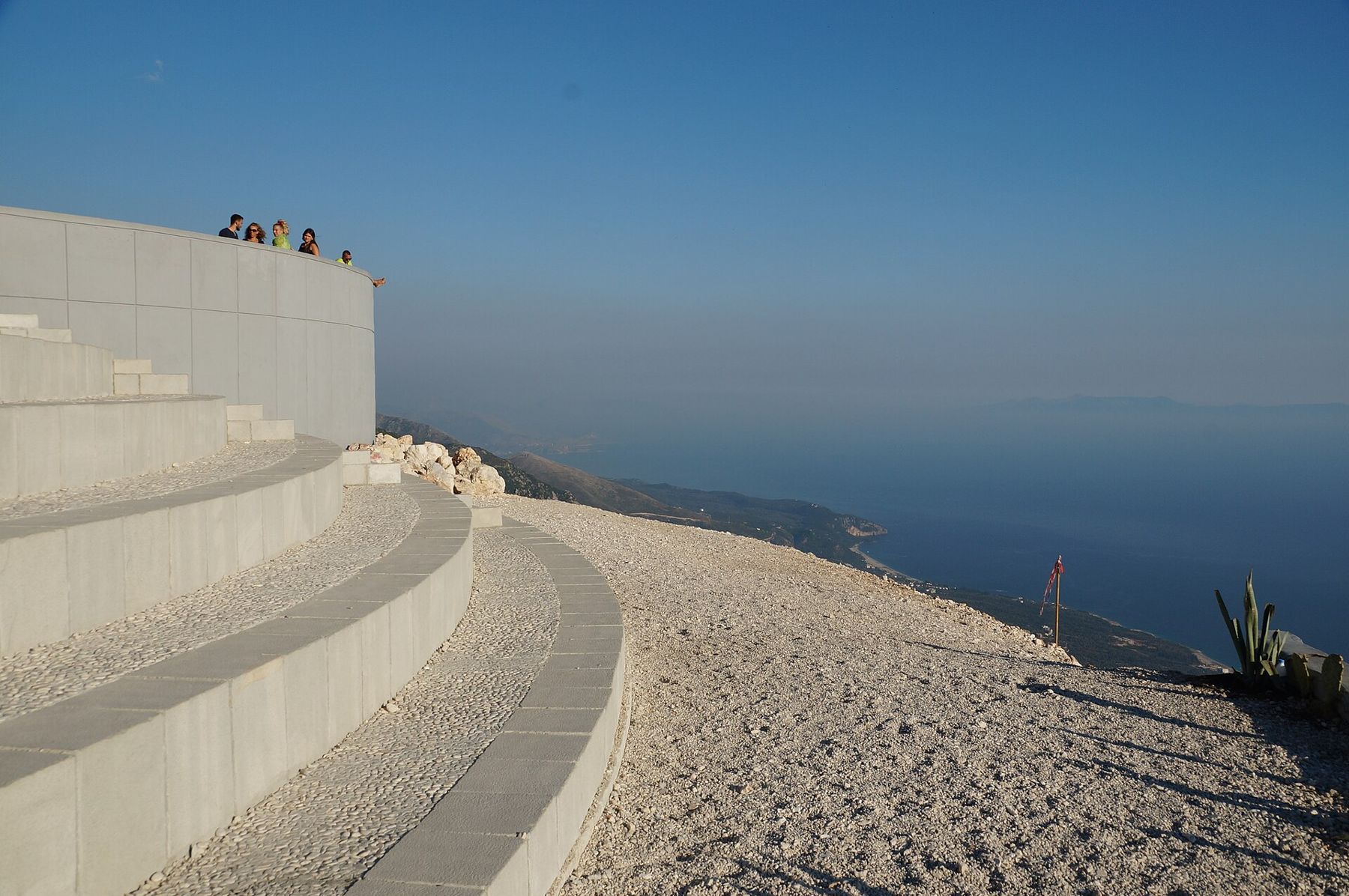
The descent is the slowest stretch of the whole coast. Hairpins stack one above the other, and lorries, buses and hire cars share them. Go down in daylight, in a low gear, and expect to stop for goats.
Dhërmi and Jalë
Dhërmi is two places. The old village hangs on the hillside above the road, a cluster of stone houses and small Orthodox churches with views straight down the coast. The beach below is the other Dhërmi: a long sweep of white pebbles and clear water that has become, over the last fifteen years, the liveliest summer scene on the Riviera, with beach bars, music late into the night and apartment blocks climbing the slope behind.
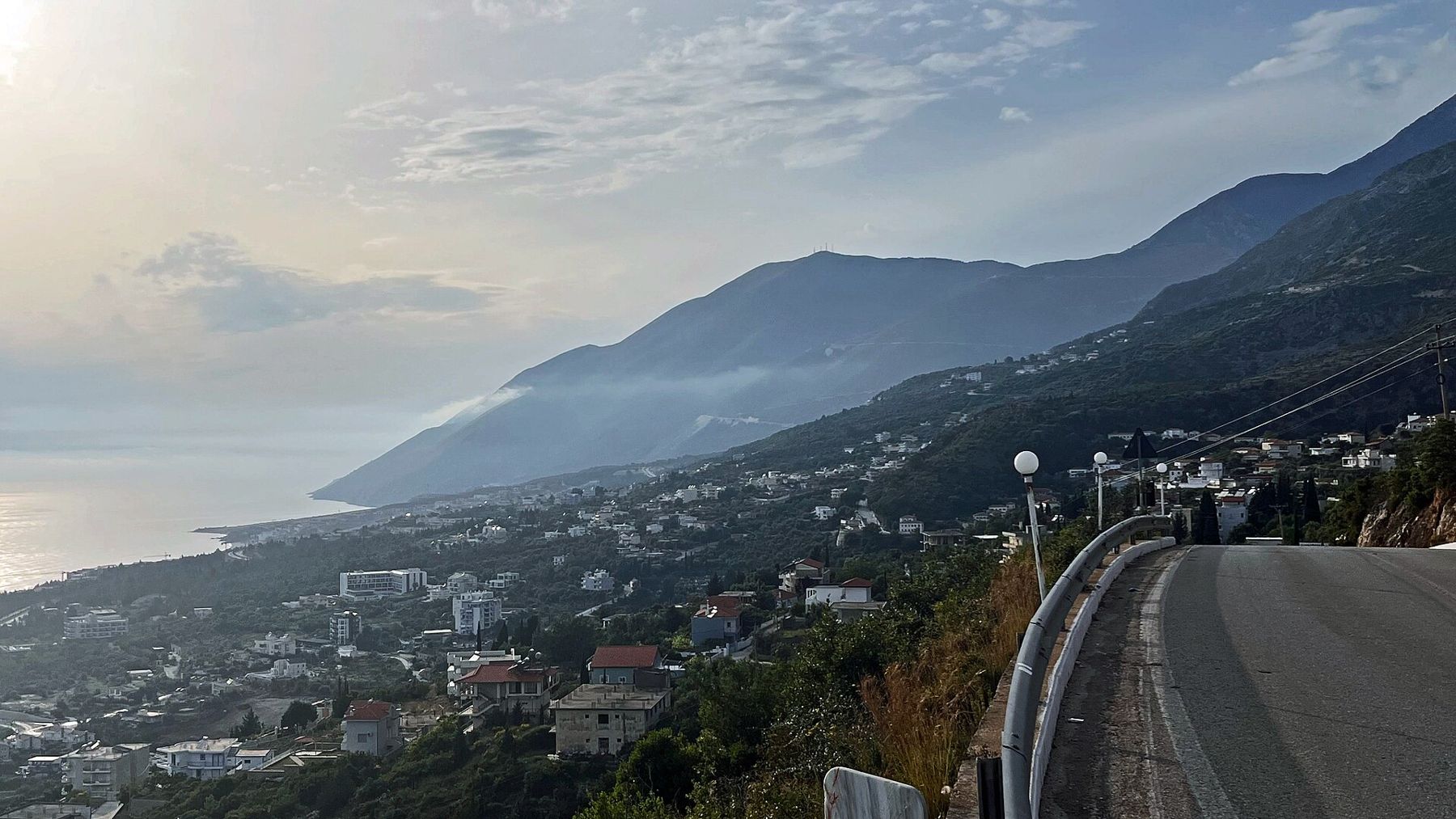
Between Dhërmi and Jalë a dirt track and then a footpath lead down a narrow canyon to Gjipe, a cove with no road to it at all. The walk takes about half an hour each way and the return is uphill in the heat, so carry water. Many people arrive by boat instead.
Jalë itself is a smaller bay with a short beach between two arms of rock. It was long a campers' cove and has filled with guesthouses, but its shape keeps it intimate, and the water stays sheltered when wind roughens the open coast.
Himarë and its castle
Himarë is the first real town on the way south, and it feels like one: a harbour, a seafront promenade, cafés open all year, a school and a bakery that serves people who live here rather than only those passing through. The town has a Greek-speaking community with deep roots, and you hear both Albanian and Greek in the streets.
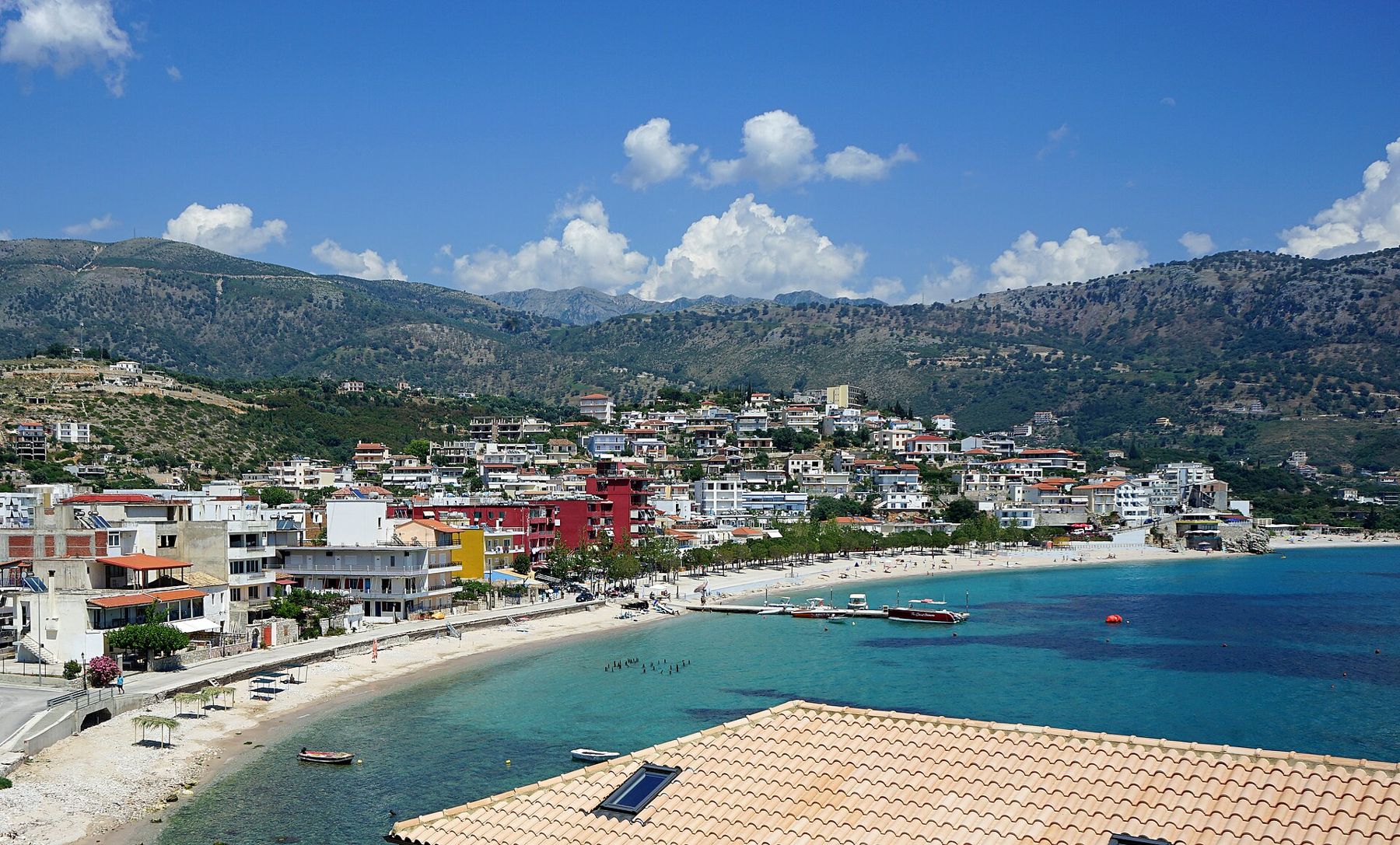
Above the modern town, on a steep hill, is the old castle quarter. Its walls enclose ruined and restored houses and churches, and the climb up rewards you with a view over the bay and the next headlands south. Down on the shore, Spile beach runs in front of the town, and a short drive or walk south brings you to Livadhi, a longer bay of pebbles framed by olive terraces.
Taken in a hurry it blurs. Taken bay by bay it makes sense.
The small port is where fishing boats tie up and where, in summer, excursion boats leave for coves that are hard to reach by land. Out of season it is very quiet, a few men mending nets and the sound of halyards against masts.
 Read nextPorto Palermo and Ali Pasha's castle
Porto Palermo
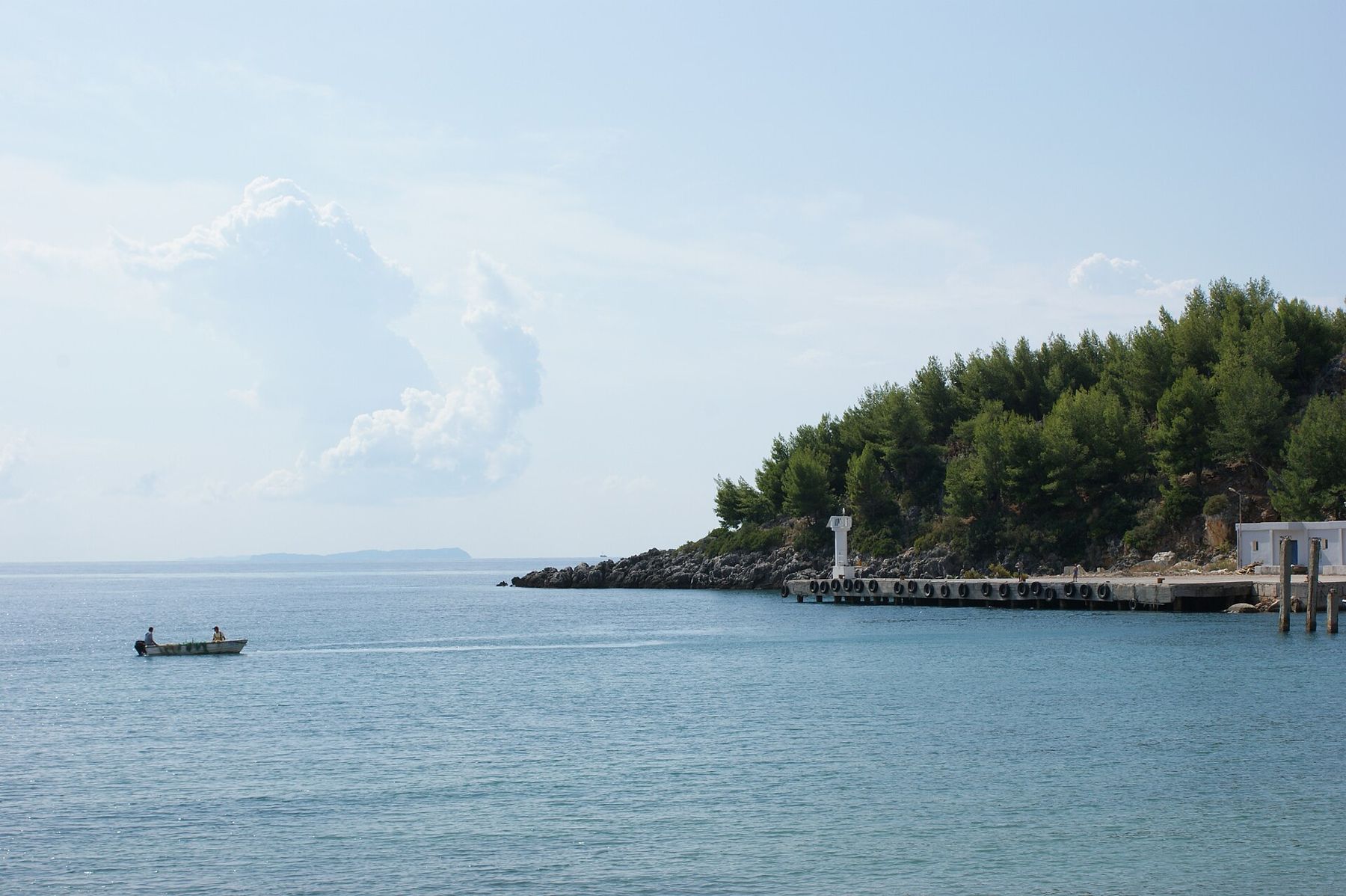
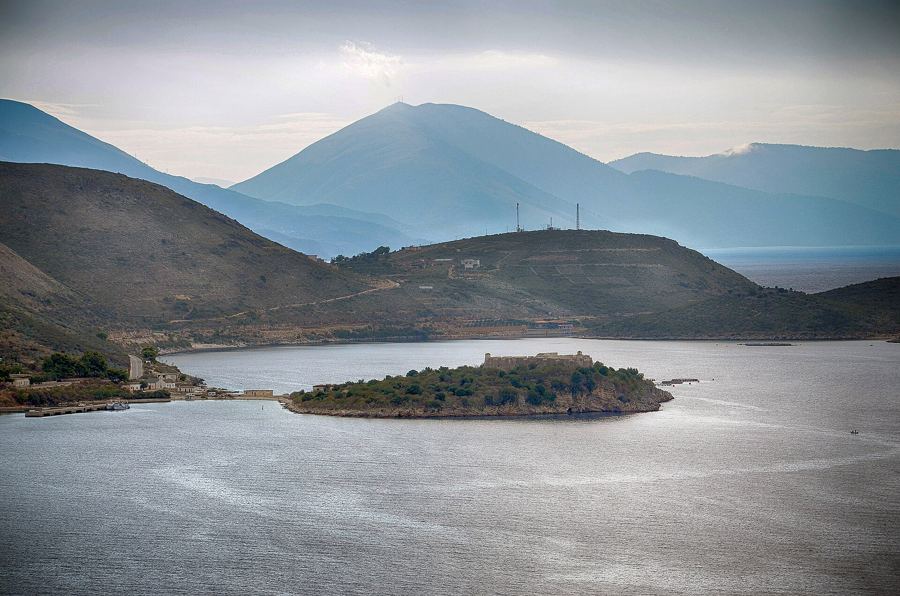
South of Himarë the road swings inland and then comes back to the sea above a deep, almost enclosed bay. On a small peninsula in the middle stands a triangular fortress usually credited to Ali Pasha of Tepelena, the Ottoman governor who ruled much of this coast in the early nineteenth century. The castle is small enough to walk round in half an hour, and its rooftop looks back across water so still it can resemble a lake.
The bay's other history is newer. In the communist years its sheltered water made it a military harbour, and a tunnel was cut into the hillside opposite for submarines. It is the clearest reminder on the coast that this shore was, for decades, a closed frontier rather than a holiday coast. Our full story on Porto Palermo covers the castle and the bay in detail.
Borsh and Lukovë
Borsh has the longest beach on the Riviera, several kilometres of pebble and sand backed not by hotels but by olive and citrus groves that climb into the hills. The development here is lower and more scattered than at Dhërmi, and on most days you can walk a long way along the waterline before anyone else appears. Above the village, on a spur, are the ruins of a castle and a mosque, and springs run down out of the limestone into the groves.
Qeparo, just to the north, is two villages in the same way as Dhërmi: an older settlement of stone houses on the mountain and a newer one by the sea. The upper village was largely abandoned during the twentieth century and is worth the drive up for its silence and its view.
Lukovë is quieter still. Its village sits high above the road, and the beaches below are reached by side tracks that drop through terraces. The coast here becomes more cut up, a series of small coves between rocky points, and the traffic thins as you approach Sarandë.
What links all these bays is the food. Almost every village has a family kitchen serving grilled fish, salads of tomato and cucumber with a slab of white cheese, and olive oil pressed from the trees on the slope behind. Lunch is long, dinner is late, and the menu follows whatever the boats brought in that morning, which is the best reason to stay a night rather than drive through.
Driving it, and when to go
The Riviera is roughly a hundred kilometres of road from Vlorë to Sarandë, and the drive can be done in a day, but that misses the point. Two or three nights, split between a northern base such as Dhërmi or Himarë and a southern one such as Borsh or Sarandë, let you swim at a different bay each day.
Buses and minibuses run along the coast, more often in summer, but schedules change with the season and are best checked locally. A hired car gives the most freedom, though parking at the busier beaches in August is a test of patience. Petrol stations exist along the route but are spaced out on the stretches between villages.
The coast changes character through the year. In June the water is warming and the villages are open but not crowded. July and August bring heat, families from across Albania and Kosovo, and diaspora visitors home for the summer, and the beach clubs are at full volume. September is the favourite of many regulars: the sea is at its warmest, the crowds thin out after the first week, and the light softens. In winter many beach businesses close, but the towns go on living, and the coast has a stark beauty under rain and clear skies.
For the southern end of the drive, our guide to Sarandë covers the town and its surroundings, and our comparison of the coast's beaches sets the bays side by side for sand, access and crowds. If you are deciding when to come, the best time to visit weighs the seasons across the whole country.
A last thing to know: the light. In the late afternoon the sun drops towards Corfu and the whole coast turns gold, the limestone glowing above the dark olive trees. Stop the car on any headland at that hour and watch the next bay south catch it.
Filed under The Coast